Schedules be damned, it’s only a short time before you hear an approaching bus.
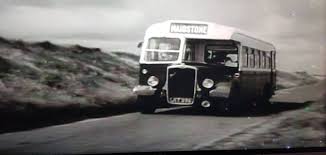
The huge machine is ancient, wheezing and stuttering to a stop. It is weather-stained, its complexion darkened by sun and water-rot. The yellow paint is worn, the sides rusted, and dark brown streaks run spidery across its hull. The grill looks almost bearded. The door creaks open, and a dim light reveals the driver, hunched in his raised seat. He doesn’t bother to look at you.
You step forward and pay the fare, and before you’ve even secured a seat, the bus lurches craggily into the night.
You are the only passenger. You try to peer out the windows but darkness has fallen cloak-like over the world. Your eye-doors of perception are useless. You don’t know where this bus is taking you, but you are too tired to be afraid anymore, too much time has passed, far too much life. Fear is for the young, for those who think they can resist fearsome things. For those who think they can run away from it all.
You finally know there’s no running away. The past is always present.
At least there is still some curiosity in you. What might wait at the other end of this ride into the dangerous country’s night? Maybe you’ll end up back at the beginning, where it all began, and not just that town by the sea—but even further back, all the way into your own distant and vague past.
As the bus chugs along, you try to piece together the little you recall. The times before these times. Childhood: wealth, privilege? Not exactly, but not poverty, either. Days on ocean shores. Tossing rocks into the sea. Watching ships in the distance, feeling sad longing. And behind you, watching all that while, your disapproving father—or was it the other way: was it you who disapproved of him? What is the genesis of disapproval? Of disappointment? All broken hearts first crack with false hope, with disappointed expectation. He: expected things for you. You: expected otherwise. And so that dull tale: disapproval, disappointment, disavowal.
And not just your father (nor for that matter your mother, quiet, withdrawn woman). Not them: the other.
The other who lies at the center of all this, who you’ve half-sensed all along. The voice in the back of your head, challenging, questioning, mocking all you thought you believed. The constant doubting jeer crowding out your own voice, leaving you only with uncertainty and hesitation. No wonder you wanted to leave. To see this to the end. How else to find the peace you need.
You are the only one who can stop it. Who can silence it forever.
A white light casts into the bus as it jounces over a mass in the road, jostling you forward. Through the window, the moon climbs above a tall canyon of trees outlining the road … and suddenly you realize that you are not, in fact, alone. There is another sitting in the bus’s back. You can’t make him out in any detail, can hardly see his form. What gives him away is a sound, a metal rasp—a lid unlidded, the wet sound of drink, lid relidded again.
“Where the devil did you arrive?”
You turn toward his voice, uncertain.
“Sleep is a rose,” another answers.
You flinch. There is yet another man there in the dark.
“Sleep is a rose,” the latter continues, “so come on, take a chance with me.”
You hold your breath, waiting to see if they’re addressing you, and tight giggles ensue. The source of the first sound is passed, another rasp, you hear gulping, the object sealed, returned. As best you can tell the men sit facing one another, having an incomprehensible conversation of fragments—
“Take him by the lamb.”
“Let’s swim out tonight.”
“Penetrate the evening?”
“Rather. The devil’d you get her?”
“The weather is getting better, you mean? Smoke?”
“No less than thou zenned girls. Or was it thou zenned thrills?”
“Funny accent there, Cappy.”
“Least I’m not responsible for the rapiers of others.”
“Tut. Poor girl. Of course no one could save her, save perhaps the blind tiger.”
“That one was a monster, black dressed in leather.”
“Killer on the road, him.”
“Try? Try.”
“Yes, quite. Try to understand.”
As they patter, you realize that they are indeed the two men from town, from the street, with that poor girl. The violence you hardly understand swells within. (Try to understand.) Your fists coil, your muscles clench, your mind sees red.
The men must sense the shift in your weather: they fall silent and sit upright, attentive.
You rise and begin approach them, but the bus jolts again, sends you stumbling back into your seat.
“Stop sixteen,” the driver says. “Door’s open, fella.”
The men watch you, four comet eyes gleaming moonlight.
“Well,” one says.