
When it falls into the surf, the mirror doesn’t even gurgle.
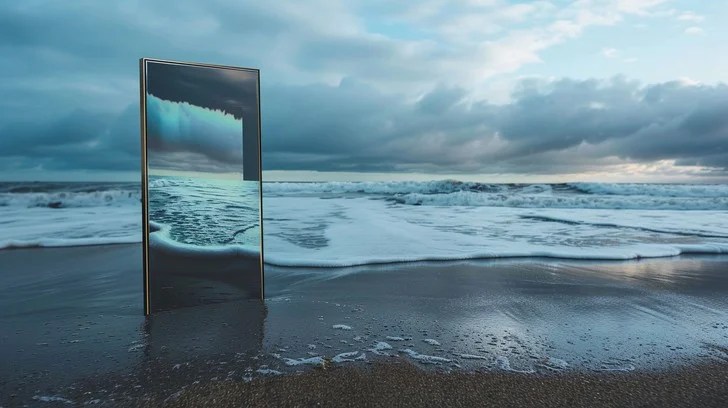
Fine. Fuck that mirror anyway.
You return to your shelter, pleased with yourself. Despite all the time that has passed since you were last faced with a real decision–not that this one was particularly hard lol–in this instance you were very decisive, you didn’t hesitate at all, stuck to your guns, your father would probably be proud.
Or maybe not so much.
Within seconds you realize your failure, the abject emptiness of your foolish action: how awful will be the awfulness of a life lived minus mirror? Despite the hour, despite the darkness, you rush back to the beach, diving blindly into the shallows, feeling about for the handle, peering into the dark surf, ignoring the rocks that slice at your feet and hands.
Where is it? Where is the mirror?
The mirror is gone.
Keep looking. And looking. And looking. What drives your sudden need for the mirror is a thing you can’t put to words, but it’s an absolutely rigid certainty that mirror equals meaning, that there is no self without being able to see the self, appraise the self. Mirror means. Mirrorless means naught. No life save by seeing the self. Don’t stop to ponder what any of this means, just act on the certainty of it and keep searching, for hours and hours, search until you can search no more, and then finally drag yourself, bleeding and bruised, back into your crude hut, weary and mirrorless and miserable, and there fall into death-deep sleep.
In the morning, when you finally wake up, you feel somehow refreshed. Was it all just a dream? If so, how much of it happened, how long have you slumbered here, etc. Clearly it wasn’t—dreams are a fog in the mind while this is a hard certainty, there was indeed a mirror in that satchel, and it was the satchel you saw on the ship before, and the mirror was there all that time, it must have been the precious cargo that would change the world, and what does that mean, and why the hell did you chuck it into the ocean in a fit of pique.
Because you’re you, and on that note, well.
Back to island life. It’s fine, it’s fine. Keep telling yourself it couldn’t have been too important, that mirrors are for shallow assholes. After all, you are still here, still in this lovely place, this is existence, it is what it is. Make the best of it. Go for a nice long morning swim. See a round-faced eel poking its head from a hole in a rock. Hi, eel. Eel blushes but soon pokes its head out again, and you catch it by the neck, swim back to shore, swing it into a tree. Roasted eel has a thoughtful chewiness. As you ruminate on eel, consider also the fire, and your lean-to shelter, consider as you have done for many weeks now your acceptance of this ramshackle if pleasant existence.
Damn.
Maybe you could do a little better.
After all, you come from a finer past.
So why not a finer future?
The next day, with a renewed sense of mission, you begin to explore the island’s interior. Two leagues distant, in a lush valley, you find a picturesque meadow that might well serve as a real home. You painstakingly make a footpath between the beach and meadow with many repeated comings and goings. You experiment, first in your mind and then beside the fire, with creating a concrete slurry: sand and gravel and water laid out to bake in the sun. You add leaves for support, a few branches, and once you’ve added clay from a creek-bank deeper in the jungle, the substance tightens nicely.
Onto structure. Gather stones, gather stones, gather stones. Sharpen stones. Whack a tree, whack, whack. Clear a flat section in the meadow. Stir slurry. Stir some more. Build, one stone at a time, a wall. Build another wall. Think: window, duh. Build a wall with a hole, and another. Time passes. The house it does get built. Move-in day is nice, the house is nice, too, especially in the rainy season, the sound of rain against the palm frond ceiling.
A few drips, though, and they’re especially annoying when you’re trying to sleep. You can do better. So: a sealed roof. Fine, that’s better. The space does seem a bit small. If a guest arrives … ? Time for an addition. Carve a road, tamping, tamping, jungle to house. Gather fragrant plants and mango seeds and other fruit seeds, cultivate a garden. It’s awfully easy, everything grows so well here, so quickly. (Wouldn’t grapes be nice? Raisins?!) You imagine your guest: Dear sir, you say to him, now, after your long day of grimy travel, why not a nice outdoor seawater shower? (Because you’ve built a nice outdoor seawater shower!) Try, you say to guest, using this lovely plant’s sap to wash your hair and skin!
(So many rashes finding the right plant.)
And over the weeks, months, and years, more stray oceanic packages (mostly FedEx, natch) wash upon shore. Of course you open these, and with such giddiness you’re almost embarrassed: have you wanted, all your life, to actually be stranded on an island? Maybe so, maybe so, which let’s not think too much on what this says about you. The packages are nearly always books. Meh, boring at first. You hoped for something else, chocolates, for example, would be quite nice. Nifty utensils. A knife. Maybe a sketchbook, some colored pencils. But, fine, books, whatever.
Eventually you enjoy reading the stories. You open the little story houses beside the fire, letting their pages fan and dry. More come via ocean waves, books upon books, so many that you build another room in the house. And shelves. You put the books on the shelves. Then you need more shelves, and they seem to attract more books, and all the books are sort of great in their own way, filled with so much information and/or lies or just varying degrees of clever nonsense, and soon you come to feel that the cleverer and more nonsensical the better. To a point.
You like them all, even the sincere ones. You use their information to improve your house even more: you put in plumbing, build an electrical generator, install lighting and a mesh wi-fi network (you can order from Amazon now). You buy cookbooks and make very efficient and totally fine tasting dishes in your Instant Pot (sake risotto ftw). You comb your hair. You take long contemplative walks. You subscribe to a subset of academic journals in which scholars make arguments about the hidden symbols and meanings and implications buried within narratives of historical novels. You take a few of these old novels off the shelf, novels you’ve already read once, if not too carefully, and through the eyes of the scholars you consider the books anew: here be signs and symbols you didn’t even realize, whoa. And, well, in fact you do start to see them, as with the stars, all the certain hidden patterns in the words. Allusions implying other meanings. Which seems like its own fun, so why not give it a try, what else do you have to do out here?
For three years you write your own article, for two more years you work up courage, and finally you send it to a journal. Amazingly, it is accepted, and four years later actually published. You write another: accepted! You are encouraged, so you read and read, searching for more deeper meanings in these books on your shelves, or more to the point searching for ways in which you might communicate all the meanings you’ve lived and found. You don’t swim as much as you used to. Sometimes, guiltily, you visit the fish in the natural pond, and they eye you suspiciously, and you feel some sorrow, that you don’t see them so often. Maybe you could relocate them: build a seawater pond in the garden.
And … done! Wipe your hands, step back, look all your work.
This house. This library. This garden.
You made all this. It gives you some pride, and why shouldn’t it? Again you imagine someone coming upon you, a visitor to this island, stumbling upon all you’ve done. Wouldn’t it be great to show this to someone? Wouldn’t they be impressed?
They would be, right … ? …. right?

