
You step through the doorway, and she’s immediately given you the slip:
the room you’ve entered is empty, the woman nowhere to be found.
You pause for bearings. It’s a dark room, cramped, packed with strange items, the air wet-warm with candleflame. A desk sits in the center, and upon it a row of candles floats in a glass bowl, the bowl half-filled with water, rocking gently. The air is tremendously thick—you almost cover your nose against the curling odor of an unemptied chamber pot.
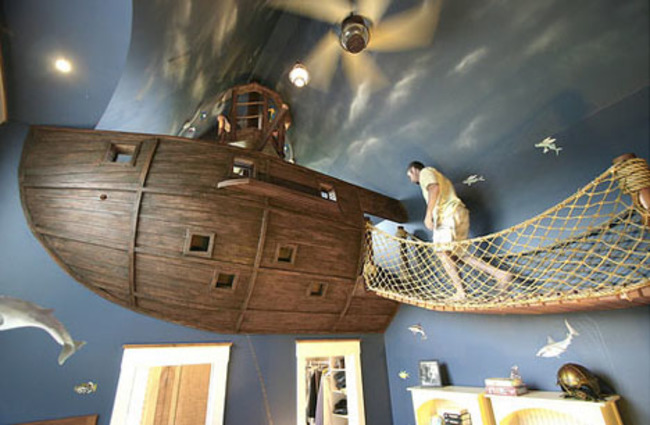
Dim light squeaks through a small window shaped like a porthole. You see that the room has a few odd trinkets: on a wall, a poster of a great white shark leaping through a flaming hoop. On a coat rack in the corner, two almost identical twin cutlasses hang, one with a red handle, the other, green; you peer closely and both are toys, stage-props. Hanging from a plastic clothes hanger on the back of the entry door is an outlandish pirate costume. Beside the porthole, a single shrunken head the size of an ostrich egg dangles, lips stitched, hair white, exploding from its skulls like a firework. One eyehole is empty and gaping; the other is covered with a patch.
A nameplate on a desk reads CAPTAIN’S QUARTERS.
But there is nothing else that suggests a “Captain’s Quarters”: no box of sea urchins, no narwhal tusk. No scrimshawed fang of a sea lion harpooned in the Aleutians, nor the harpoon itself, that beloved a totem of his younger, fitter years, when the captain whose life you’re suddenly really imagining with a lot of fervor would leave the ship and take part in the hunt, this long before he was the captain, before the grim dullness of responsibility, of how many lbs salt-peter, how many lbs biscuit and lime, having to cheer up the glum first-mate and keep an eye on the cook. Back when he was just a sailor like yourself, beset by a stirring up in his soul, a competition of sorts against the general humming thrust of mankind, the emptiness of society, that mad tinny clamor—when he, like you, turned his gaze to the sea.
Not here. This is no room of any captain you’ve ever seen.
In fact, save the swaying little head and its tenderly red-stitched mouth, and save the costume and the swords, you find yourself in a place quite familiar, and almost disturbingly so. This isn’t a stranger’s room in a strange town: this could be your childhood bedroom, or anyway a room rigged to resemble it. That small bed in the corner with the cartoon-themed comforter set atop it messily. The shark poster. The alarm clock done in the style of the football helmet of your favorite childhood team (the alarm it sounds a tinny reproduction of applause). The little bookcase topped with pictures of your dog Lizardo—you can’t help feel a sudden lump in your throat, recalling the sad end to that poor puppy. The pirate costume—your own from many years ago.
And of course, on a bookshelf, the pictures of you and your sibling, the one who left when you were young, the sibling you hardly knew, who ripped himself asunder from your life.
To say the least, this is unsettling. To find this place of memories, here in this town, in this strange building – wherever it is that you are – to find it here after who knows what led you here. Not just the woman in the street … not just the body you wanted to check on … but before that, the original impulse to leave home, to get away from it all and … do what. Do something, anyway.
Suddenly the room shifts, the candles sway, you feel unbalanced. You realize that the air smells of salt; the sea is seemingly pulling the boat within which this room resides to and fro. What trick is this? What game is afoot?
A black object on the captain’s desk – your desk – rings.
You lift the receiver to your ear.
“We can see you,” a crackling electric voice says. “We know what you are doing. And we will do everything we can to stop you. Aren’t you tired by now, wearied by all this stepping through door after door? Searching after strangers rumored to be this or that villain? Doesn’t it always end the same? One way or the other?”
As if to better hear, the shrunken head turns toward you.
“You know the truth,” the voice continues. “Death is always the realest ending. The most satisfying one. Don’t forget what happened. The dog. The highway. The past.”
It is a suddenly such a soothing voice, this voice that has always been inside you, confiding, questioning. “Why don’t you step through that door you entered. Go back on this ship’s deck, it says. Go over to the side. It’s lovely, really, a placid nighttime out here, after all; the seas are becalmed; go on out there, gaze down into the black ocean; there you will find staring back at you not only all within the ocean but all that it reflects, the twinned sky, deep space, all the stars below you and above you and wouldn’t you like to exit, to step away to a place better than the mad one you’re now in? Wouldn’t it be better to fall into and reside with the sea, the stars? They are the calm and quiet that you have been seeking. They are the resting spot.
Go on. They’re waiting for you.“
The phone clicks.
Or perhaps better to sit here awhile, calm thyself, maybe even take a nap.
 home
home 