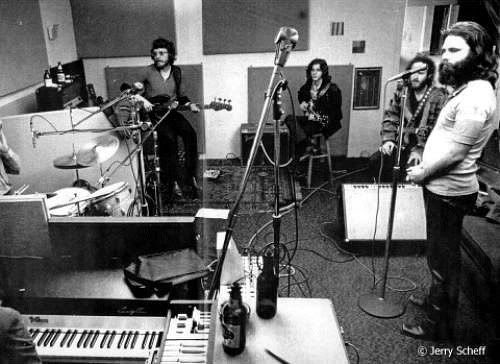
It’s an early spring evening, and you’re sitting on the cold vinyl floor of a sound studio on Sunset Boulevard, watching a band called The Doors record a rhythm track.
On this evening they are gathered in uneasy symbiosis,
and the studio is too cold and the lights are too bright and there are masses of wires and banks of the ominous blinking electronic circuitry with which musicians live so easily. There are three of the four Doors. There is a bass player borrowed from a band called Clear Light. There are the producer and the engineer and the road manager and a couple of girls reading each other’s palms and a Siberian husky named Nikki with one gray eye and one gold. There are paper bags half filled with hard-boiled eggs and chicken livers and cheeseburgers and empty bottles of apple juice and California rosé. There is in fact quite a bit of there there, there is everything and everybody The Doors need to cut the rest of this third album except the fourth Door, the lead singer, Jim Morrison, a 24-year-old graduate of UCLA who wears black vinyl pants and no underwear and tends to suggest some range of the possible just beyond a suicide pact.
Ray Manzarek is hunched over a Gibson keyboard. “You think Morrison’s going to come back?” he asks no one in particular.
No one answers.
Time passes. It’s worth asking yourself: why are you here? Partially it’s the straight line of your lineage, high achieving academic that you are, excellent education, wealthy family, and this suits your ambitions in life–to get closer to celebrity but to hold it at arm’s length, to study it, record it, put it down on the page. This is the power you will enjoy for a long time, until you don’t, until you realize that strangers don’t matter quite so much as the self.
Other reasons, too. Maybe a bit nonsense about Blake and Huxley, that trivial reference that pulls you in after it, the old rabbit hole of factoids: I wonder if…and the phone opens one door, and the IMDB page another, and the Google search all the rest, and to what end? You wonder why you wonder the things you wonder, and how your wonderings lead in turn to wanderings, and how these wondering-wanderings have led you to this strange, lifeless studio that seems to exist out of time, like a room in a bad French novel, a place between life and death. Even the dog seems fake. Krieger unwinds a string as the dog sighs and falls back into sleep.
You don’t move. You don’t want to disturb the bizarre stillness, it’s the Mead in you. You are here as a pair of eyes, watching; as a mind, recording. You can smell the pee-greasy intestine of the fried livers. The room is salty, tired. Perhaps you shouldn’t be so prone to idle musings. Do not wonder, you think: Act. Do. Mean. Take every–
“I wonder what Blake said,” Manzarek muses. He looks directly at you, but his blue eyes are still and distant. “Too bad Morrison’s not here. Morrison would know. Morrison is our leader. He’s the very best at planning leadership conferences. Don’t you all think? Hm?”
No one responds. The lifelines resume, and it’s a long while later when Morrison arrives. He sits down on a leather couch in front of Nikki, who ignores him, and four big blank speakers, who nod politely, and closes his eyes. Krieger continues working out a guitar passage. Densmore tunes his drums. Manzarek twirls a corkscrew as a girl rub his shoulders.
What do you do. What there is there to do but wonder.
An hour or so has passed when finally Morrison speaks to Manzarek, almost in a whisper. “Depending on traffic,” he says, “it’s an hour to West Covina. Even with our FastPass.” Krieger pauses, mid-strum, and shrugs. “It should be fine,” he says, “we’ll be against traffic. Plus we can take the 60 instead of the 10.” “Or the 705 to the 105,” Densmore suggests. “That’d put us near the airport.” “What’s near the airport?” Krieger asks. Densmore grins. “That rad bar, man.”
Morrison seems impatient. “West Covina,” he repeats, “is an hour away. We should spend the night out there after we play. In West Covina.” Manzarek puts down the corkscrew. “We could get in a rehearsal,” Morrison continues, “there’s a Holiday Inn next door.” “We could,” Manzarek says. “Or we could rehearse Sunday, in town.”
Morrison stands, agitated. “I really think we should stay the night in West Covina.”
The others quiet. Manzarek looks at him for a while, then goes back to fiddling with the console. Nikki wags tail. Morrison stands, looking from person to person. He doesn’t see you. No one commits to interacting with him, and the situation stretches back into its emptying yawn. You count the control knobs on the electronic console. Seventy-six. You are unsure in whose favor the dialogue has been resolved, or if it has been resolved at all, and this is the point: the lack of resolution: the scattered nature of things: the lack of rather than a presumed divide between heaven and hell: the marriage in the corporeal form: this body, do thee take this mind: I do, I do, ado. Krieger complains that he needs a fuzz box. Morrison sits down again on the leather couch and lights a match. He studies the flame, then lowers it to the fly of his black vinyl pants. Manzarek watches sadly. The girl rubbing Manzarek’s shoulders does not look at anyone.
No one is ever going to leave this room—this is the END.